Singapore Method for Mathematics: Benefits and Principles
The Singapore method is a pedagogical approach to teaching mathematics that is recognized worldwide for its effectiveness. It is characterized by a methodical progression from the concrete to the abstract, allowing children to deep understanding of mathematical concepts rather than just memorizing procedures. This method, used in more than 10,000 schools across 160 countries, offers considerable benefits for learning: it develops critical thinking, improves problem solving and creates a positive relationship with mathematics from an early age.
Singapore method takeaways:
- Three-step progress: → abstract → pictorial concrete
- Development of deep understanding rather than memorization
- Significant improvement in problem-solving capabilities
- Proven results in international Pisa assessments
- Montessori-compatible approach for younger children
What is the Singapore Method for Mathematics?
The Singapore Method is an approach to teaching mathematics developed in Singapore in the 1980s. Faced with the disappointing results of their students, the education authorities of this small country have completely rethought their way of teaching mathematics, resulting in a system that has propelled their students to the forefront of the world in international assessments such as Pisa.
Fundamentals of the Singapore Method
The method is based on a few fundamental principles that distinguish it from traditional approaches:
- CPA progression (Concrete-Pictorial-Abstract) : This three-step sequence allows students to first manipulate concrete objects, then to visually represent the concepts, before finally moving on to mathematical abstraction.
- Deep understanding : The focus is on understanding concepts rather than memorizing procedures.
- Problem solving : At the heart of the method is the ability to solve complex problems by mobilizing various strategies.
- Bar modeling : A distinctive visual technique for representing and solving problems.
- Mastering the fundamentals : A limited number of concepts are taught each year, but in depth.
This approach used in the Private Primary School of Bilingual Boulogne-Billancourt has shown its effectiveness in leading students to develop a solid understanding of mathematics and to build a positive relationship with this discipline.
The benefits of the Singapore method for learning
Deep understanding rather than superficial memorization
Unlike traditional methods that often emphasize memorizing algorithms and formulas, the Singapore method encourages students to understand why these procedures work. This deep understanding has several advantages:
- Better long-term knowledge retention
- Increased ability to apply concepts in new contexts
- A reduction in mathematical anxiety, as students understand what they are doing
- A development of mathematical intuition that facilitates the learning of new concepts
Development of critical thinking and problem solving
The Singapore method emphasizes problem-solving as the primary vehicle for learning. Students regularly face situations that require them to:
- b. Analyzing complex information.
- Develop resolution strategies
- Justify their reasoning
- Evaluate the relevance of their solutions
These skills go far beyond mathematics and prepare students to face the challenges of the 21st century, where critical thinking is more valued than simply memorizing facts.
A visual and concrete approach that promotes inclusion
The progression from concrete to abstract makes it possible to reach all students, regardless of their learning styles. Visual representation of problems through bar modeling is particularly beneficial for:
- Students who have difficulties with abstract mathematical language
- Visual learners who need to “see” problems to understand them
- Students with specific learning disabilities
This inclusive approach allows more students to succeed in mathematics, reducing learning inequalities.
Concrete-pictorial progression-abstracts: the heart of the method
Step 1: Concrete learning through manipulation
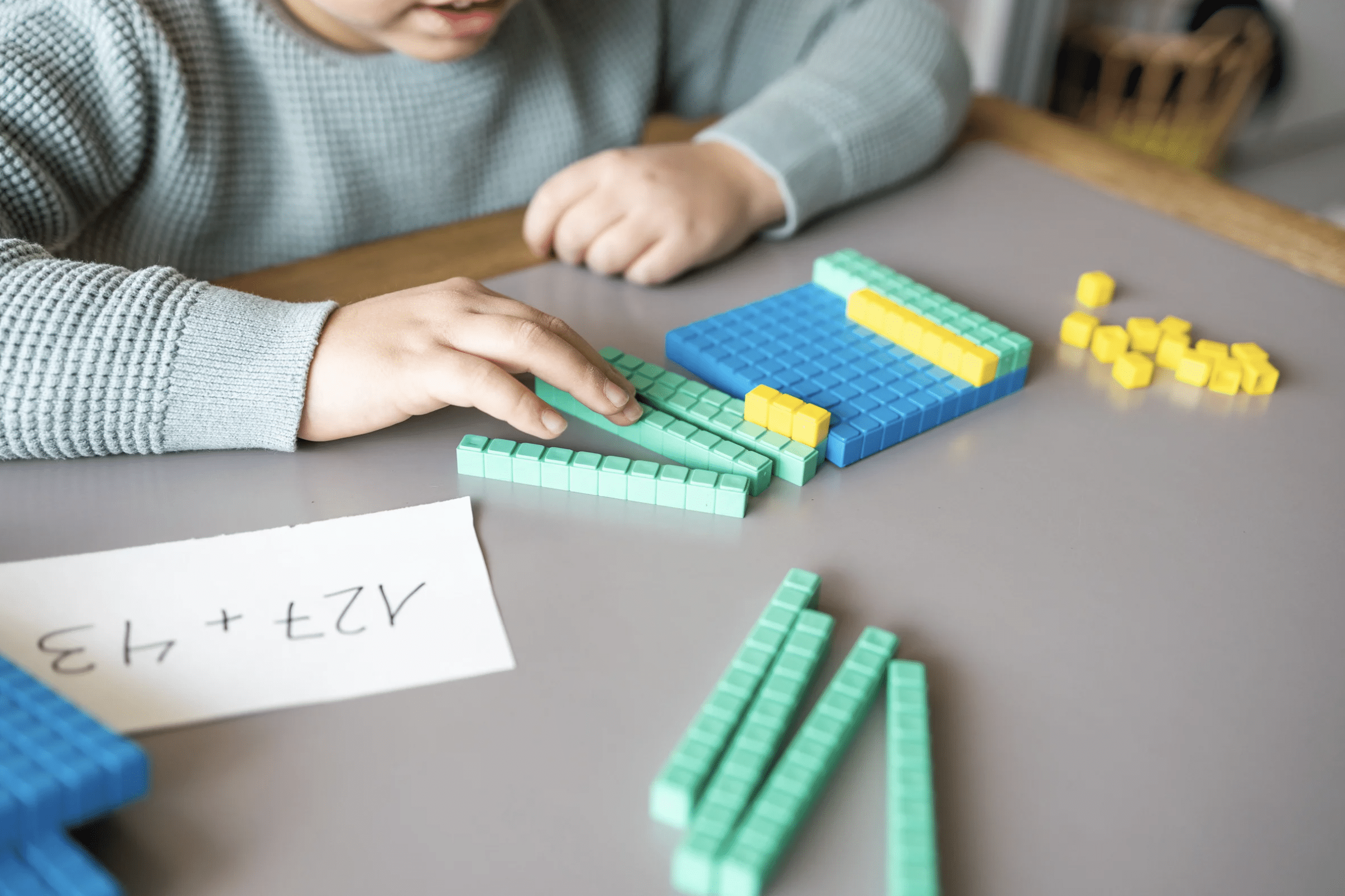
In the first phase, students manipulate physical objects (cubes, tokens, rulers, etc.) to explore mathematical concepts. This step is fundamental because it allows children to:
- Build a direct and sensory experience of concepts
- Building strong neurological connections
- Discover mathematical properties for themselves
For example, to understand addition, students will first manipulate concrete objects to visualize the combination of two quantities.
Step 2: Pictorial representation
Once students are comfortable with concrete manipulation, they move on to pictorial representation of concepts. It is at this stage that the famous bar modeling, a distinctive visual technique of the Singapore method. This representation makes it possible to:
- Visualize mathematical problems
- Establish relationships between quantities
- Determine the operations necessary for resolution
This intermediate step serves as a bridge between the concrete and the abstract, greatly facilitating the transition.
Step 3: Mathematical abstraction
In the final phase, students move on to mathematical symbols and abstract procedures. Through the previous steps, this abstraction is approached with a solid understanding of what symbols represent. Students can then:
- Use mathematical notation effectively
- Applying procedures with understanding
- Solve complex problems with confidence
This natural progression respects the child's cognitive development and allows for a smooth transition to abstract thinking.
Comparison with traditional mathematics teaching in France
Differences in pedagogical approach
Traditional mathematics teaching in France has several notable differences with the Singapore method:
- Focus on procedures : The French approach has long favoured learning algorithms and procedures, sometimes to the detriment of understanding.
- Faster progress : French programs generally cover more concepts each year, but with less depth.
- Less visual shoring : Visual representations such as bar modeling are used less systematically.
- Steeper transition to abstraction : The transition from concrete to abstract is often faster, which can leave some students struggling.
These differences may partly explain the worrying results of French students in international assessments, where 29% of students are struggling in mathematics compared to only 7% who reach a high level, according to the latest Pisa results.
Outcomes compared
Countries that have adopted the Singapore method or similar approaches (Singapore, Hong Kong, South Korea, Japan) regularly rank at the top of international assessments in mathematics:
- Singapore consistently tops the Pisa rankings for mathematics
- Students in these countries show a better conceptual understanding
- They particularly excel at solving complex problems
- The gap between the best-performing and the lowest-performing students is generally smaller
Faced with these results, many countries, including France, are increasingly interested in this method, and the Ministry of National Education is gradually encouraging its adoption.
The implementation of the Singapore method in the classroom
A concrete example: learning subtraction
To illustrate the Singapore method in action, let's take the example of learning subtraction:
- Concrete phase : Students use cubes or tokens to represent a number, then physically remove a quantity from it to understand the concept of “removing.”
- Pictorial phase : They draw bars representing the quantities, then cross out or surround the part to be subtracted, thus visualizing the operation.
- Abstract phase : After understanding the concept, they move on to classical mathematical writing (8 – 3 = 5) with a solid understanding of what these symbols represent.
This progression allows students to develop an intuitive understanding of subtraction, far beyond the simple application of a procedure.
Organizing a typical lesson
A mathematics lesson according to the Singapore method usually follows this structure:
- Anchoring : Review of previous knowledge needed for the new lesson
- Guided Discovery : Exploring a concrete problem that introduces the new concept
- Modeling : Explicit demonstration of how to represent and solve the problem
- GUIDED PRACTICE : Similar exercises carried out with the support of the teacher
- Independent Practice : Autonomous work on various problems
- Reflection : Discussion on strategies used and learnings achieved
This balanced structure allows students to gradually build their understanding and confidence.
Tools and resources needed
To effectively implement the Singapore method, several resources are needed:
- material to stimulate manipulation : Interlocking cubes, tokens, rulers, etc.
- Workbooks and Exercise Books : Several publishers offer French adaptations of Singaporean textbooks
- Teacher training : Specific training is desirable to understand the philosophy and techniques of the method
- Visual aid : Posters, mind maps and other tools to facilitate the representation of concepts
The investment in these resources is largely outweighed by the progress made by students.
The Singapore method in the French school context
Gradual adoption in French schools
In recent years, the Singapore method has been gaining ground in French schools:
- Official experiments were conducted in several academies
- Many private schools have adopted it as their primary approach
- Resources adapted to the French program are now available
- The Ministry of National Education encourages its use in the face of disappointing results on international assessments
This adoption is part of a desire to renew mathematics teaching in France to improve student outcomes.
Compatibility with official programs
The Singapore method fits well within the framework of French programs:
- It covers all the concepts required by the common core of skills
- Its progress is compatible with the expectations of each cycle
- It perfectly meets recent recommendations on explicit teaching and manipulation
- It aligns with the focus on problem solving in current programs
Schools like • my school who adopt this approach can therefore do so while respecting institutional requirements.
The challenges of transitioning to this method
Despite its advantages, adopting the Singapore method presents some challenges:
- The need to train teachers in a different approach
- The need to adapt certain cultural aspects specific to Singapore
- The initial investment in educational resources
- Potential resistance to change on the part of different actors
However, these challenges are not insurmountable, as the successful experience of many Schools having made this transition.
The links between the Singapore method and Montessori pedagogy
Although of different origins, the Singapore method and Montessori pedagogy share several commonalities that make them particularly compatible.
Complementary philosophies
Both pedagogical approaches share fundamental values:
- The importance of handling : Both methods recognize that children learn best by manipulating concrete objects
- Respect for the child's rhythm : They value individual progression and mastery of concepts before moving on to the next step
- Emphasis on deep understanding : Both approaches prioritize conceptual understanding over memorization
- Learner autonomy : They encourage children to discover for themselves and develop their independence
These philosophical similarities explain why many Schools inspired by Montessori naturally adopt the Singapore method for mathematics.
The ideal transition from kindergarten to elementary
The Singapore method offers a smooth transition for students who have benefited from a Montessori pedagogy in kindergarten:
- Montessori students are already accustomed to manipulating concrete material to understand mathematical concepts
- They have developed an autonomy in learning that prepares them well for the Singapore method
- Their experience of progressing from concrete to abstract with Montessori material (digital bars, golden beads) is echoed in Singapore's CPA approach
- Their ability to work at their own pace is in line with the mastery philosophy advocated by the Singapore method
This educational continuity allows students to capitalize on their achievements while adapting to the increasing demands of elementary school.
The application of the Singapore method to 123 my school
In the Schools • my school, the Singapore method is implemented rigorously and adapted to the French context.
An integrated approach to the elementary curriculum
À • my school, the Singapore method is fully integrated into the elementary cycle curriculum (CP-CM2) in the Courbevoie and Boulogne-Billancourt establishments. It is part of a program that meets the requirements of National Education while enriching it:
- Mathematics according to the Singapore method represents about 5 hours per week
- The approach is complemented by other subjects taught according to French and international standards
- Teachers are trained specifically in this method to ensure its effectiveness
Observable outcomes in students
The use of the Singapore method in • my school produces tangible results:
- Students develop a positive relationship with mathematics
- They show a thorough understanding of fundamental concepts
- Their ability to solve complex problems is significantly improving
- They show greater autonomy in their work
These observations confirm the effectiveness of the method and its relevance in the context of a bilingual school with high academic ambitions.
Continuity with the Montessori approach in kindergarten
• my school ensures a smooth transition between the Montessori pedagogy practiced in kindergarten and the Singapore method used in elementary school:
- The mathematical achievements developed with Montessori material in kindergarten (sense of quantities, numbering, concrete operations) serve as a solid foundation
- The progression from the concrete to the abstract, central to both approaches, allows for methodological continuity
- The autonomy and confidence developed in kindergarten are valued and reinforced by the Singapore method
This pedagogical continuity ensures that students take full advantage of their educational path to • my school, with strong foundations that effectively prepare them for the aftermath of their schooling.
Common Questions
From what age is the Singapore method used at 123 my school?
The Singapore method is used in the elementary cycle (CP-CM2) to • my school, from 6 years old. It is implemented in our establishments in Courbevoie and Boulogne-Billancourt. This method represents about 5 hours per week in our mathematical program.
Does the Singapore method completely replace the National Education curriculum?
No, the Singapore method does not replace the National Education curriculum but enriches it. Our elementary level follows the official curriculum of the National Education while preserving the values of the Montessori pedagogy. The Singapore method is used as a pedagogical approach to teaching mathematics, while respecting the objectives of the common foundation of skills.
How does the Singapore method relate to the bilingualism of 123 my school?
À • my school, l’enseignement est 100% bilingue dès le CP avec une répartition équilibrée entre le français (12h/semaine) et l’anglais (12h/semaine). La méthode Singapour pour les mathématiques est enseignée principalement en français (5h/semaine), tandis que des mathématiques selon les standards Cambridge sont également enseignées en anglais (4h30/semaine). Cette double approche renforce la compréhension des concepts mathématiques dans les deux langues.
Quelle est la différence entre la méthode Montessori et la méthode Singapour pour les mathématiques ?
La pédagogie Montessori et la méthode Singapour partagent des principes similaires comme l’importance de la manipulation et la progression du concret vers l’abstrait. Toutefois, la pédagogie Montessori est une approche globale qui touche tous les aspects du développement de l’enfant et utilise du matériel spécifique (barres numériques, perles dorées). La méthode Singapour est plus spécifiquement centrée sur l’enseignement des mathématiques, avec une séquence structurée et une modélisation en barres caractéristique. À • my school, nous utilisons la pédagogie Montessori en maternelle (3-6 ans) puis la méthode Singapour en élémentaire (6-11 ans) pour les mathématiques.
Les parents doivent-ils connaître la méthode Singapour pour aider leurs enfants ?
Il n’est pas nécessaire que les parents maîtrisent la méthode Singapour pour soutenir leurs enfants. À • my school, nous organisons des échanges réguliers avec les familles et des journées portes ouvertes pour expliquer notre approche pédagogique. Nous fournissons également des ressources et des conseils aux parents qui souhaitent se familiariser avec cette méthode. L’équipe pédagogique reste disponible pour répondre aux questions des parents et les guider dans l’accompagnement de leur enfant.
Comment évaluez-vous les progrès des élèves avec la méthode Singapour ?
À • my school, nous privilégions une évaluation continue plutôt que ponctuelle. Les enseignants observent régulièrement les progrès des élèves et adaptent leur enseignement en fonction des besoins identifiés. Nous utilisons des évaluations formatives pour comprendre les potentielles difficultés et ajuster les approches pédagogiques. Cette méthode permet de suivre le développement de chaque enfant et de proposer une remédiation pédagogique si nécessaire, tout en respectant le rythme propre de chacun.