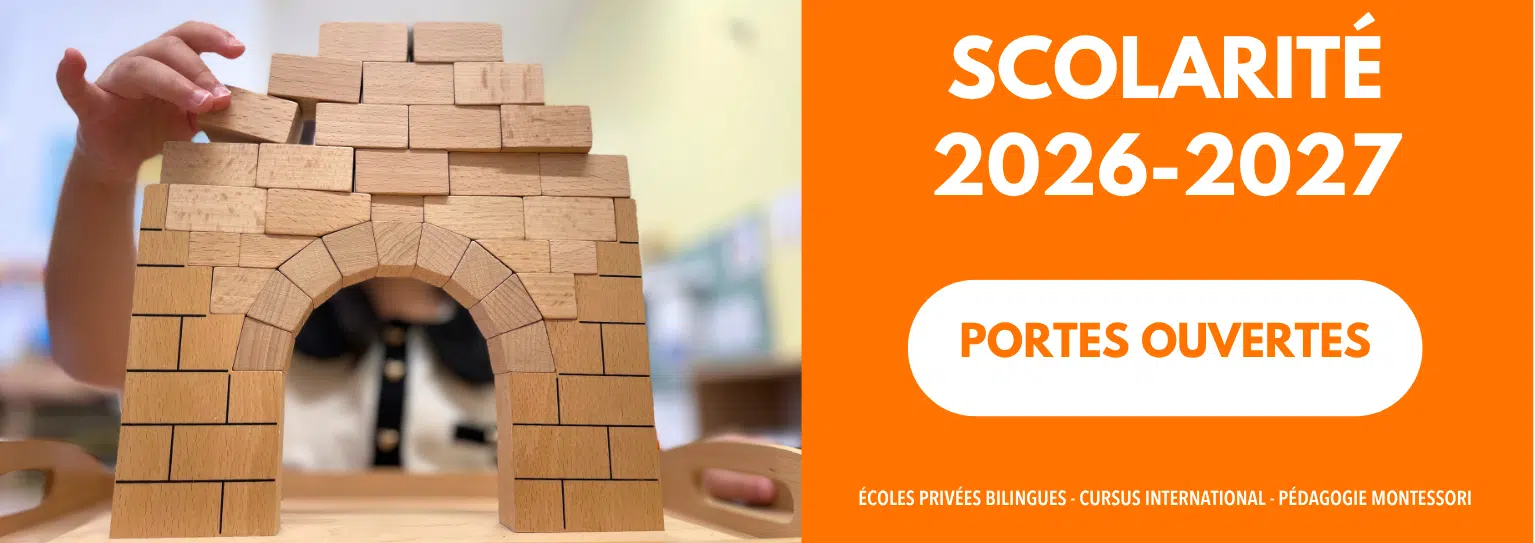
Montessori method of education;

Promote self-confidence, autonomy, while allowing the child to evolve at his own pace and in complete freedom

Maria Montessori
cause of children. "To educate is not to train" advocates the one that,
in January 1907 opened the first Children's House.
Its revolution? Provide children with equipment
adapted, but above all, leave them free to choose their own
activities they want to do, for as long as they want to.
She then notices, with surprise, that the toddlers are able
to show unexpected concentration and self-discipline.
This is how Montessori pedagogy is born: as soon as the child is in a conducive and prepared environment, accompanied by an educator who adapts to him and stimulates him, the child learns by himself, at his own pace.

4 years of schooling to discover nearly 300 different activities
During consistent learning cycle, the child discovers the material as a whole. He learns alongside two graduate educators, a Anglophone and a dutch speaking, who take turns teaching him how to practice the material, distributed in 5 large work areas.

Certification obtained from the MCI (Montessori Center International)
Invited by 123 my school, the MCI spent a few months in our schools to assess our professional practices,Trail diversity of our teaching materials, as well as our bilingual framework and our relationships with families.
We are proud of this accreditation which confirms the quality work carried out in our schools.
Montessori pedagogy around the world
For nearly 100 years, Montessori pedagogy has been recognized worldwide for its ability to developing the child's full potential, à serve her curious and joyful nature.
It is the most common form of teaching in the world.
The basics and main principles of Montessori pedagogy
Within the same class, the Ages are the: Mixed, in kindergarten from 3 to 6 years, in order to promote Mutual assistance mutual and theTraining between the children
The environment must be structured, clean and tidy.
Furnishings adapted the strength and size of the child.
The material always remains accessible so that the child can handle autonomouslyFor there is freedom of choice.
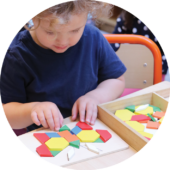
Material must be respected and handled With care,.
It is simple, beautiful and noble.
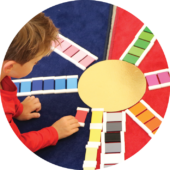
The adult has a role of guide who observes and lets the child experiment, while remaining at his disposal.
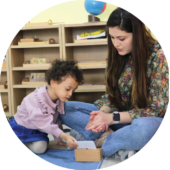
The child needs to manipulate objects to organize and coordinate his movements.

The practice of Montessori pedagogy at 123 my school:
a great adventure between educators and children!

The 5 Montessori areas in videos
PRACTICAL INFORMATION
Motor skills and autonomy
Perfecting the movement
Prepare for writing
Taking care of yourself and your environment
Doing useful things on a daily basis
Sensory life
Refine your senses
Developping fine and overall motor skills;
Getting started with writing and mathematics
Refining your senses
Prendre conscience de son environnement
Le langage
Lire et écrire
Apprendre à lire et à écrire
Enrichir son vocabulaire et son expression orale
Utiliser un vocabulaire précis pour nommer chaque chose
Améliorer la communication
Les mathématiques
Algèbre et géométrie
Apprendre à compter et comprendre la valeur des nombres
Accéder à des concepts abstraits tels que les nombres entiers, les 4 opérations, les nombres décimaux, les fractions, …
Approcher les notions d’aires, de volumes, de formes géométriques…
La découverte du monde
Expérimenter et découvrir
Explorer la géographie, la botanique, le monde animal, la nature et les sciences
Please add an image
Please add an image
Please add an image
Please add an image
Please add an image