How to Choose a Montessori Private School in Paris: A Complete Guide
Choosing a Montessori school in Paris and its surroundings for a 3-year-old child requires special attention to several essential criteria. Parents should ensure that the montessori certificationCheck the quality of teaching materials and take an interest in the Educator training thus than years of experience. This approach makes it possible to distinguish real Montessori schools from establishments that only partially adopt this pedagogy. Observing the prepared environment and the interactions between educators and children remains crucial to make an informed choice, adapted to your child's unique development.
Montessori certifications: guarantees of authenticity
Montessori education attracts many parents, but not all schools that claim it meet the same standards. To identify an authentic Montessori school, the Official certifications constitute a first reliable indicator.
Recognized Certification Bodies
Two main bodies issue internationally recognised Montessori certifications:
- ASSOCIATION MONTESSORI INTERNATIONALE : Founded by Maria Montessori herself in 1929, it represents the strictest certification and faithful to the original pedagogy.
- MCI (Montessori International Centre) : British organisation recognised for its rigour and approach in line with the fundamental principles of Montessori.
These certifications ensure that the school follows the authentic principles of Montessori pedagogy. 123 My school obtained the MCI certification in April 2020, attesting to the quality of its educational approach after a rigorous analysis of its professional practices.
The prepared environment: key to Montessori learning
One of the pillars of Montessori pedagogy is The Prepared Environment, specially designed to promote the autonomy and natural development of the child. When visiting a school, his close observation will inform you about the quality of the pedagogical approach.
Characteristics of an authentic Montessori environment
A well-prepared Montessori environment has several essential characteristics:
- Space orderly and accessible where every piece of equipment has its place
- From child-sized furniture to promote their autonomy
- Some materials arranged on open shelves, sorted by learning area
- Une atmosphère. calm and bright conducive to concentration
- Some plants and natural elements integrated into the space
Dans les écoles 123 mon école, l’environnement est spécifiquement conçu pour être lumineux, adapté, chaleureux et sécurisé. Chaque détail est pensé pour permettre aux enfants d’évoluer librement et de développer leur autonomie dès le plus jeune âge.
Le matériel Montessori
Le matériel Montessori constitue l’essence même de cette pédagogie. Lors de votre visite, observez attentivement :
- The qualité et l’état du matériel : il doit être en bon état, complet et fabriqué avec des matériaux naturels autant que possible
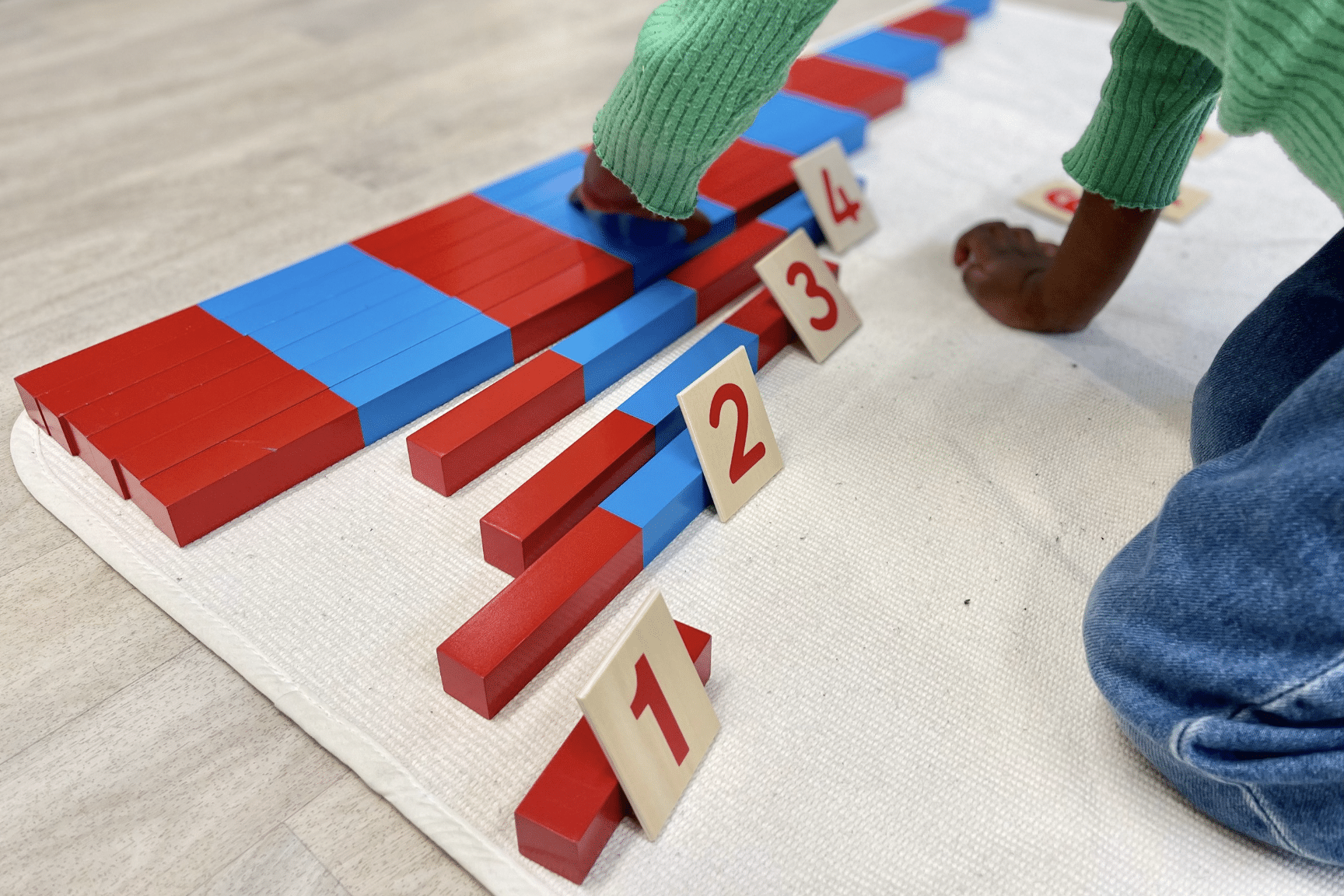
- The présence des matériels emblématiques : tour rose, cylindres colorés, lettres rugueuses, barres numériques, etc.
- L’organisation par domaines d’apprentissage : vie pratique, sensoriel, mathématiques, langage, culture
Un matériel authentique est conçu pour être auto-correctif, permettant à l’enfant d’apprendre par lui-même et de développer son indépendance. À 123 mon école, par exemple, le matériel de vie pratique inclut des plateaux de transvasement et des cadres d’habillage, tandis que l’apprentissage des mathématiques s’appuie sur des barres numériques et des perles dorées.
Points à retenir sur l’environnement Montessori
- L’espace doit être adapté à la taille et aux besoins des enfants
- Le matériel est organisé par domaines d’apprentissage
- L’environnement favorise l’autonomie et la concentration de l’enfant
- La présentation et l’état du matériel reflètent le sérieux de l’établissement
- L’atmosphère générale doit être calme, ordonnée et stimulante
La formation des éducateurs : pilier de la qualité pédagogique
Les éducateurs sont au cœur de la réussite d’une école Montessori. Leur formation spécifique et leur adhésion à la philosophie Montessori et leur expérience éprouvée garantissent une application de cette pédagogie.
Les certifications professionnelles
A défaut d’une expérience pluriannuelle, un éducateur Montessori qualifié devrait avoir suivi une formation initiale. Les formations les plus réputées sont délivrées par :
- ASSOCIATION MONTESSORI INTERNATIONALE : la formation la plus fidèle à la vision originelle de Maria Montessori
- MCI (Montessori International Centre) : formation britannique reconnue internationalement
- NAMC (North American Montessori Center) : formation nord-américaine respectée
- ISMM (Institut Supérieur Maria Montessori) : formation française de qualité
À 123 mon école, la majorité des éducatrices possèdent des diplômes supérieurs complétés par des formations spécifiques d’éducatrices ou d’assistantes Montessori délivrées par des organismes reconnus comme NAMC, MCI ou AMI/ISMM. Cette double qualification assure une compréhension approfondie tant du développement de l’enfant que des principes Montessori. Plusieurs éducatrices ont également une formation de base d’enseignante, avec un diplôme MEEF.
Questions essentielles à poser sur l’équipe pédagogique
Lors de votre visite d’une école Montessori, n’hésitez pas à poser ces questions cruciales concernant l’équipe éducative :
- Quelle est la formation et l’expérience de chaque éducateur ?
- Quel est le ratio adultes/enfants dans chaque classe ?
- Comment se déroule la formation continue des éducateurs ?
- Depuis combien de temps les éducateurs pratiquent-ils la pédagogie Montessori ?
- Comment l’équipe communique-t-elle avec les parents sur les progrès de l’enfant ?
Une école Montessori de qualité maintient un ratio adultes/enfants permettant un accompagnement individualisé. Par exemple, dans les classes maternelles de 123 mon école, on trouve deux éducatrices permanentes (une francophone et une anglophone) pour 15 à 20 enfants, ce qui permet une attention personnalisée tout en favorisant le bilinguisme.
Les différentes approches Montessori : stricte vs adaptée
Il existe différentes interprétations de la pédagogie Montessori, allant de l’application stricte à des adaptations plus souples. Comprendre ces nuances vous aidera à choisir l’école qui correspond le mieux à votre vision éducative.
L’approche Montessori stricte
L’approche Montessori stricte ou « orthodoxe » se caractérise par :
- Une adhésion rigide aux principes établis par Maria Montessori
- L’utilisation exclusive du matériel Montessori traditionnel
- Des classes d’âges mélangés (3-6 ans, 6-9 ans, 9-12 ans)
- L’absence d’évaluations traditionnelles et de devoirs
- Une grande liberté laissée à l’enfant dans le choix de ses activités
Cette approche privilégie le respect absolu du rythme de l’enfant et de son développement naturel, sans pression extérieure.
L’approche Montessori adaptée
L’approche Montessori adaptée intègre les principes fondamentaux tout en les complétant par d’autres méthodes pédagogiques :
- Combinaison du matériel Montessori avec d’autres supports pédagogiques
- Intégration de certains éléments des programmes nationaux d’éducation
- Introduction d’activités collectives dirigées en complément du travail autonome
- Adaptation aux exigences contemporaines (langues étrangères, arts plastiques, culture musicale et sportive…)
C’est cette approche adaptée que pratique 123 mon école, qui combine la pédagogie Montessori avec les exigences du programme de l’Éducation nationale et un enseignement bilingue français-anglais.
Comment choisir entre les différentes approches
Pour déterminer quelle approche conviendrait le mieux à votre enfant, posez-vous ces questions :
- Quelles sont vos attentes concernant la préparation au système scolaire traditionnel ?
- Votre enfant a-t-il besoin d’un cadre très libre ou bénéficie-t-il d’un certain guidage ?
- L’apprentissage des langues étrangères est-il une priorité pour vous ?
- Quelle importance accordez-vous à la conformité avec les programmes nationaux ?
Une visite approfondie des établissements vous permettra d’observer l’ambiance de classe et d’évaluer si l’approche proposée correspond aux besoins spécifiques de votre enfant.
Aspects pratiques et logistiques à considérer
Au-delà de la pédagogie, plusieurs aspects pratiques entrent en jeu dans le choix d’une école Montessori à Paris.
Localisation et accessibilité
La proximité de l’école avec votre domicile ou votre lieu de travail est un facteur important à considérer :
- Temps de trajet quotidien pour votre enfant
- Options de transport (métro, bus, possibilité de stationnement, vélo)
- Présence d’espaces verts à proximité pour les activités extérieures
Les écoles 123 mon école sont stratégiquement situées à Paris 15e, Asnières-sur-Seine, Bois-Colombes, Courbevoie et Boulogne-Billancourt, avec une attention particulière portée à la proximité d’espaces verts comme le Square Cambronne à Paris ou le Parc des Bruyères à Bois-Colombes, permettant des sorties quotidiennes des enfants.
Frais de scolarité et services complémentaires
Les écoles Montessori étant privées, leurs tarifs varient considérablement. Renseignez-vous sur :
- Les frais d’inscription et de scolarité annuels
- Les frais supplémentaires (repas, fournitures, sorties)
- Les options de garde périscolaire (avant/après l’école, mercredi, vacances)
- Les possibilités de bourses ou de réductions (fratries, etc.)
Beaucoup d’écoles Montessori proposent des services complémentaires. Par exemple, 123 mon école accueille les enfants à l’afterschool de 16h à 18h, des ateliers le mercredi et pendant les vacances (holidays camps), accessibles même aux enfants non-inscrits à l’école.
Il s’agit d’un investissement non négligeable, qui se doit d’être le reflet d’un niveau de qualité et d’exigence.
Continuité pédagogique
Pensez à l’avenir scolaire de votre enfant en vous renseignant sur :
- Les niveaux proposés par l’école (maternelle uniquement ou jusqu’à l’élémentaire)
- Les partenariats éventuels avec d’autres établissements
- L’expérience de l’école concernant la transition vers le système traditionnel
- La typologie des écoles que fréquentent les élèves après leur départ
Certaines écoles ont progressivement étendu leur offre pour assurer une continuité pédagogique. Débutant avec la prématernelle et la maternelle en 2012, le groupe scolaire 123 mon école propose désormais un cycle élémentaire (CP-CM2) à Courbevoie et Boulogne-Billancourt, avec des projets d’expansion de ce cycle dans d’autres écoles du groupe scolaire. Le niveau élémentaire suit le programme de l’Education nationale et des curriculum anglophones, tout en préservant les valeurs de la Montessori Montessori.
Common Questions
Quelle est la différence entre une école Montessori certifiée et non certifiée ?
Une école Montessori certifiée a reçu l’accréditation d’organismes comme l’AMI (Association Montessori Internationale) ou le MCI (Montessori Centre International). 123 mon école a obtenu la certification MCI en avril 2020, après une analyse rigoureuse de ses pratiques professionnelles, assurant une évaluation de la qualité des contenus pédagogiques et de l’encadrement. Les écoles certifiées garantissent que leurs éducateurs ont suivi des formations Montessori et que la pédagogie appliquée respecte fidèlement les principes fondamentaux établis par Maria Montessori.
Comment s’organise une journée type dans une école Montessori bilingue ?
Dans une école Montessori bilingue comme 123 mon école, les enfants évoluent dans un environnement où deux éducatrices permanentes (une francophone et une anglophone) sont présentes en classe toute la journée, assurant une immersion complète dans les deux langues. La journée alterne entre des périodes de travail individuel où l’enfant choisit librement ses activités parmi le matériel Montessori disponible, et des moments collectifs (lecture d’histoires, chansons, activités dirigées). Les repas et les activités quotidiennes sont également des moments d’apprentissage où les enfants développent leur autonomie. Des activités spécifiques comme la musique, les arts plastiques et la motricité sont intégrées au programme hebdomadaire.
Mon enfant doit-il parler anglais avant d’intégrer une école Montessori bilingue ?
Non, aucun niveau d’anglais n’est requis pour intégrer une école Montessori bilingue comme 123 mon école. Le programme est conçu pour permettre un apprentissage naturel de l’anglais, quel que soit le niveau initial de l’enfant. La présence permanente d’éducatrices anglophones permet une immersion quotidienne qui favorise l’acquisition naturelle de la langue. La pédagogie différenciée permet à chaque enfant de progresser à son propre rythme, maintenant ainsi sa motivation. Cette approche est accessible à tous les enfants, indépendamment de leur niveau initial en anglais ou en français.
Comment les écoles Montessori assurent-elles la transition vers le système scolaire traditionnel ?
Les écoles Montessori comme 123 mon école préparent les enfants à la transition vers le système traditionnel en combinant l’approche Montessori avec les exigences du programme de l’Éducation nationale. En élémentaire, l’école utilise des méthodes comme Cambridge pour l’anglais ou la Méthode Singapour pour les mathématiques, qui assurent une solide acquisition des fondamentaux tout en respectant les standards académiques internationaux. Le programme de l’élémentaire à Courbevoie et à Boulogne-Billancourt est conçu pour garantir que les enfants maîtrisent pleinement les compétences requises par l’Éducation nationale, facilitant ainsi leur intégration ultérieure dans des établissements classiques ou internationaux.